Waste plastic film is one of the most common yet most troublesome materials in the recycling industry — light, thin, easily tangled, and often covered in dirt. Recently, a client from Burkina Faso in West Africa successfully launched a film recycling project with our 200 kg/h plastic granulating line. In this case study, we share the customer’s background, the complete line configuration, and how this plant turns dirty LDPE and PP film into clean, uniform plastic pellets that sell well locally.
Customer Background: A Growing Recycling Business in West Africa
The client comes from Burkina Faso, a landlocked country in West Africa, where large volumes of waste LDPE and PP film are generated every day — shopping bags, packaging film, agricultural mulch film and more. These films are cheap to collect but almost worthless until they are processed. His business plan is practical and proven in many markets: collect local waste film at low cost, process it into uniform plastic pellets, and sell the pellets to manufacturers who make new plastic products.
Although this was his first time purchasing a complete plastic granulating line, he knew exactly what he needed from the very first conversation: the raw material (LDPE/PP film), the required capacity (around 200 kg per hour), and the electrical standard for his workshop (380V, 50Hz). A buyer with clear requirements like this deserves an equally clear and fast answer — and that is exactly how we started.
Customer Requirements and the Challenges of Film Recycling
Recycling plastic film is very different from recycling rigid plastics like bottles or buckets. Before quoting, our engineering team summarized the key challenges of a film granulating project:
- Film tangles easily. Soft, thin LDPE film wraps around rotating shafts, so ordinary conveying and crushing equipment jams constantly.
- Film is dirty and wet. Dust, sand, and moisture must be washed away before extrusion, or pellet quality suffers badly.
- Pellets must be clean and uniform. Local buyers pay according to pellet quality, so the plastic granulating line needs reliable filtration and stable, two-stage extrusion.
Based on these requirements, we recommended a complete film crushing, washing, and pelletizing solution — a full plastic granulating line that covers every step from dirty waste film to finished pellets, instead of just a single granulator machine.
The Plastic Granulating Line Configuration We Recommended
After confirming the details of his raw material, our engineers designed this 200 kg/h plastic film granulating line:
| Stage | 设备 |
| 喂料 | Belt conveyor feeder with anti-tangle loop belt (no film wrapping) |
| Crushing | Heavy-duty 600 type film crusher (30 kW, 10 blades, 80 mm screen holes) |
| Washing | Screw washing machine + 5 m washing tank with V-type slag discharge and 2 disc feeders |
| 烘干 | Spin-dry vertical hoister + horizontal centrifugal dryer |
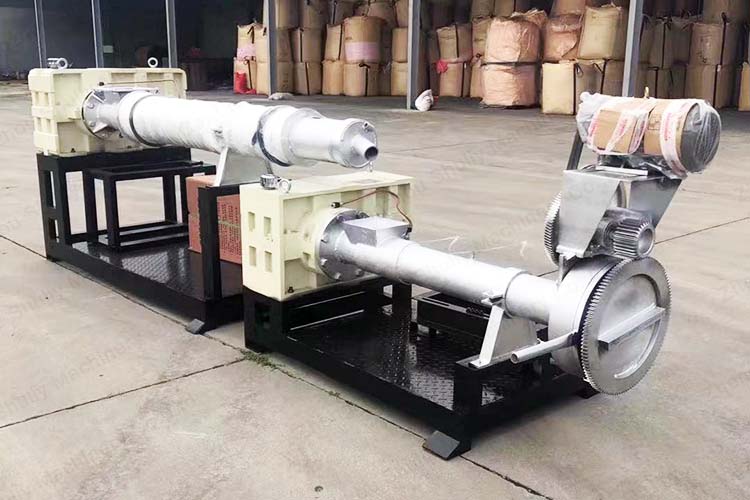
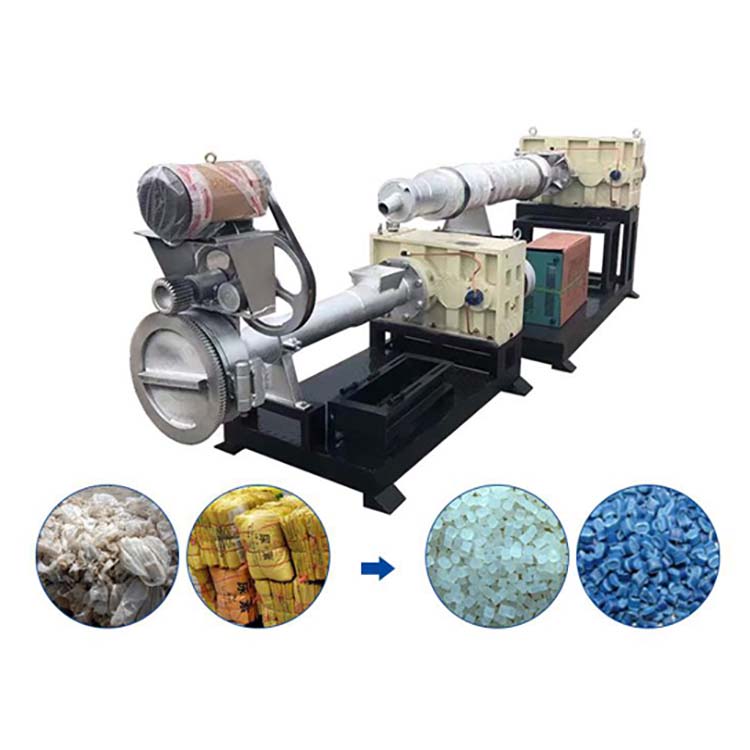
| Extrusion | 150 main extruder (45 kW) + 140 second-stage extruder (22 kW) with 60 kW electromagnetic heating |
| Filtration | Gear screen changer for removing remaining impurities |
| Pelletizing | 3 m stainless steel cooling tank, vibrating dewatering and air-blowing unit, roller-type pellet cutter |
| Storage | 1 t air-blowing stainless steel storage silo |
| Support | Auto blade sharpening machine, integrated control cabinets with reliable brand electrical components (380V, 50Hz) |
Several details were selected specifically for film material. The loop belt feeder runs without tangling; the crusher uses a 12 mm thick screen bottom suitable for film flakes; and the washing tank has a V-shaped bottom for easy discharge of sand and impurities. Every rotating shaft is dynamically balanced, so the washing and drying machines of this plastic granulating line stay stable even at high speed.
How This Plastic Film Granulating Line Works
The production flow of this plastic granulating line is easy for local operators to learn:
- Feeding and crushing. Waste film is fed onto the belt conveyor and delivered to the heavy-duty crusher, where it is cut into small flakes.
- Friction washing. The flakes enter the screw washing machine and the washing tank, where high-speed friction removes sand, dust and labels.
- Dewatering and drying. A vertical spin-dry hoister and a horizontal centrifugal dryer remove most of the remaining water, so the material enters the extruder in good condition.
- Two-stage extrusion and filtration. This is the key to high-quality film pellets. The 150 main extruder plasticizes the material first; the 140 second-stage extruder re-plasticizes it, while the screen changer filters out remaining impurities. Even slightly wet or contaminated film still comes out as dense, clean pellets.
- Cooling, cutting and packing. The extruded strands are cooled in the water tank, dried by vibration and hot air, cut by the roller-type pelletizer, and blown into the storage silo — ready to be bagged and sold.
Results After Installation
After installation and commissioning, the customer’s plastic granulating line reached its target output of around 200 kg per hour of LDPE/PP pellets. The finished pellets are dense, uniform and clean enough to sell to local plastic product factories, turning previously worthless waste film into steady revenue.
From our follow-up communication with the client, three things stood out during the whole project:
- A fast, detailed quotation. Because he told us his material and capacity clearly, we replied with a complete configuration and quotation quickly — no back-and-forth delays.
- Real, verifiable cases. Sharing videos and photos of working plastic granulating lines delivered to other customers helped him confirm we are a real manufacturer with proven machines.
- Consistent follow-up. From the first inquiry to the start of production, every question about configuration, operation and spare parts was answered promptly.
Planning Your Own Plastic Granulating Project?
Whether you recycle LDPE film, PP woven bags, agricultural film or other waste plastics, we can configure a plastic granulating line to match your raw material, capacity and budget — from a small 100 kg/h granulating machine to a complete washing and pelletizing plant. Tell us your material and target output, and our engineers will reply with a tailored solution, layout drawing and a competitive plastic granulating machine price.
Contact us today for a free quotation and a working video of our plastic granulating line in operation.